
Finding the time and space for self-reflection can be a challenge as we succumb to the pressures of modern life. Expressive writing offers a powerful avenue for self-discovery, allowing us to tap into our innermost thoughts, feelings, and experiences. Through the act of writing, we create a dialogue with ourselves that can lead to insights about our nature and help us uncover information about ourselves.
During my time as an English teacher, I found that providing students with open-ended writing time allowed them space to work through different issues. I’d often see thinly-veiled characters clearly based on friends or teachers they were having issues with, or see glimmers of issues they’d discussed with me symbolised through monsters in their stories, self-insert characters that illuminated and fixed their insecurities. I’ve noticed it in my own writing, too.
I often use journaling or creative writing as an outlet for emotions and issues I’m facing in my life. I can use it to explore possible resolutions or just use it as a way to pour those emotions out of myself and into a new vessel.
I’ve always loved writing as an artistic endeavour, particularly writing descriptions. However, I sometimes get myself hung up on grammar and technicalities instead of using it as something purely expressive, which is what I want to explore in today’s blog.
Expressive writing doesn’t have to be about perfect grammar or intricate prose that would make Shakespeare proud – of course you can turn it into that later, but you should always take a draft stage where you don’t worry about this. The draft is a beautiful opportunity to explore emotions and project your voice onto the page, to allow thoughts to flow out of you uninhibited by rules and regulations.
Allowing yourself to write in this way can be freeing. Perhaps in and of itself, it is a form of poetry – a form of writing that opens up the opportunity to write without rules.
Putting pen to paper is a wonderful outlet that allows us to express, organise and clarify that which is inside of us. It can be difficult to unlearn some of the thoughts of perfection and correctness that have been drilled into us from school, but ultimately, writing is a form of communication. As long as you can understand what you are saying, the communication is serving its purpose.
Methods for Unlearning Habits of Perfection
If you’re new to expressive writing, there are a few ways to try and let go of this idea of perfection:
- Engage with freewriting. A therapist once shared this method with me, where I was not allowed to remove my pen from paper for a set amount of time. This could be something as small as three minutes to get me going. If words aren’t coming through you, scribble, draw loops or lines – just keep the pen moving. Don’t revise your language as you write until after.
- Play word association. Write one word down and stem words from this. Eventually sentences may come to you, questions you want to delve into or even answers and revelations. You could start with your name, what you think makes you as a person and expand from there. Writing in this short form rather than in prose can help you focus on the key ideas instead of expressing something perfectly.
- Remind yourself that language constantly evolves. As I mentioned above, writing is a form of communication. Consider how you type when texting compared to writing a longer piece or a job application. These different forms of communication have different audiences and purposes; your expressive writing only needs to be understood by you. It doesn’t have to be poetic in the draft stage; it doesn’t have to be grammatically correct; it doesn’t have to be prize-winning. It just has to help you communicate with yourself.
Prompts for Exploring Yourself
Often, it can be hard to know where to start, what facets of your life you want to explore, or what questions you want to answer. To get started on your own journey of self-discovery through writing, consider the following prompts:
- What’s in a name?
Consider the meaning of your name – forenames, surname, middle names. Where did it come from culturally? What does it literally mean? Do you like the sound of it? Is there a story to your name – were you named after someone or something? Do you think there’s any sense of nominative determinism (the theory that people gravitate towards jobs that fit their names) from your name? - A letter to my past self
Choose a formative period of your life – perhaps a time of difficulty, or even just five years ago. How did you get past the difficulty? What were you working on? What advice would you give to your younger self? Do you think the younger you would be happy with where you are now? How are you different to this version of you? - A turning point in my life
Similar to a letter to your past life, identify a point in your life in which you changed dramatically. Did your perspectives shift? Did you take a direction you thought you wouldn’t? What do you think caused this change in trajectory? How do you think your life would be different if you had taken a different course? Which outcome do you think would make you happier? - Defining happiness
What do you think is the happiest you’ve ever felt? What caused you to feel this way? Try and recall the day in as much detail as possible. Who were you with? What were you doing? Why do you think this made you happy?
I write letters to my past self quite regularly, especially when I feel like my life isn’t quite on track. Although my life hasn’t always turned out the way I thought it would when I was younger, I think teenage me would be proud at how assertive I’ve become. She would be excited to know I tried things, that I travelled. I think she’d be shocked at how independent I’ve become and how comfortable I am in my own skin. She’d probably be a bit dismayed that I never wrote a best-selling novel or became a journalist, perhaps she’d question some of my relationships.
Writing these letters lets me find a sense of peace in the fact that, although I’ve not always met the expectations I had for myself, I’ve made progress and handled things I never thought I would. They allow me to acknowledge my past aspirations and then evaluate whether this is really the tragedy I sometimes think it is.
I think engaging with these prompts, or any form of reflective writing that isn’t just for publishing or public viewing, can provide a creative outlet that also opens up space for healing. They can be applied to different situations – perhaps you can explore grief or anger by writing to someone no longer there, you can give yourself a happy ending or explore ‘what if’ scenarios. You may be surprised at the catharsis you experience through just expressing something, even if just to a notebook.
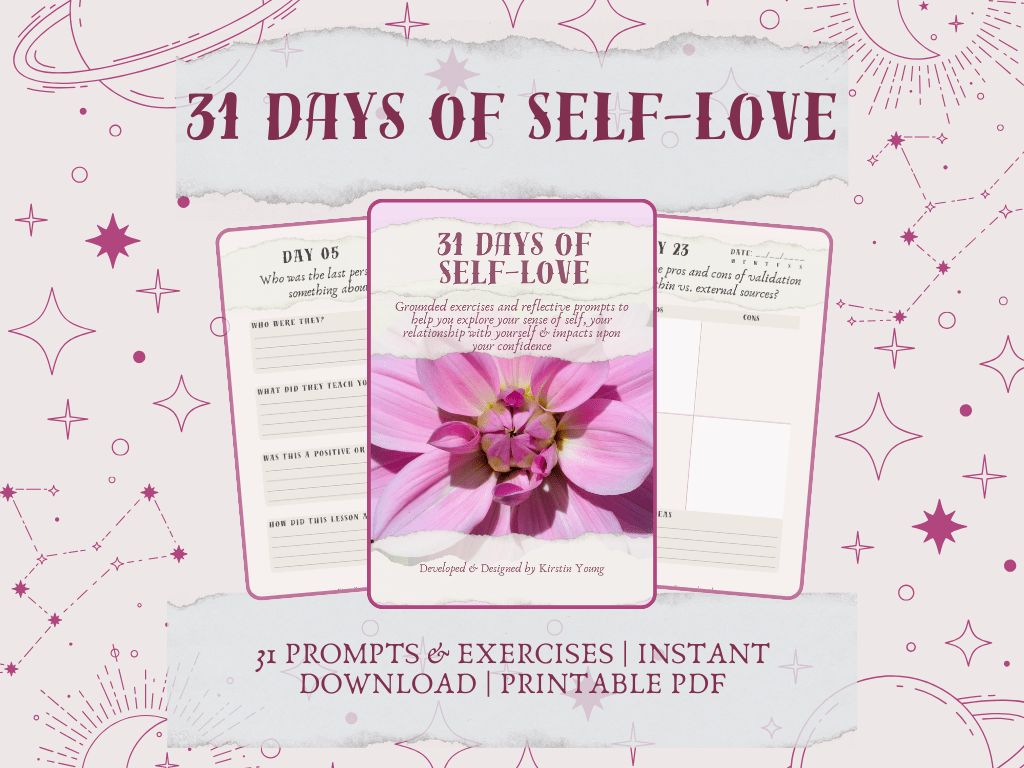
If you’re looking for structured writing prompts to support your self-discovery, I have several reflective eBooks available via Ko-Fi and Etsy for digital download 🙂



I hope some of these prompts are useful in exploring your sense of self and navigating and processing your experiences. Do you have any writing exercises you engage with when you need some time to reflect?


 The Opaque Elephant
Leave a reply to Winter Journal Prompts: 40 Questions to Ask Yourself – The Opaque Elephant Cancel reply