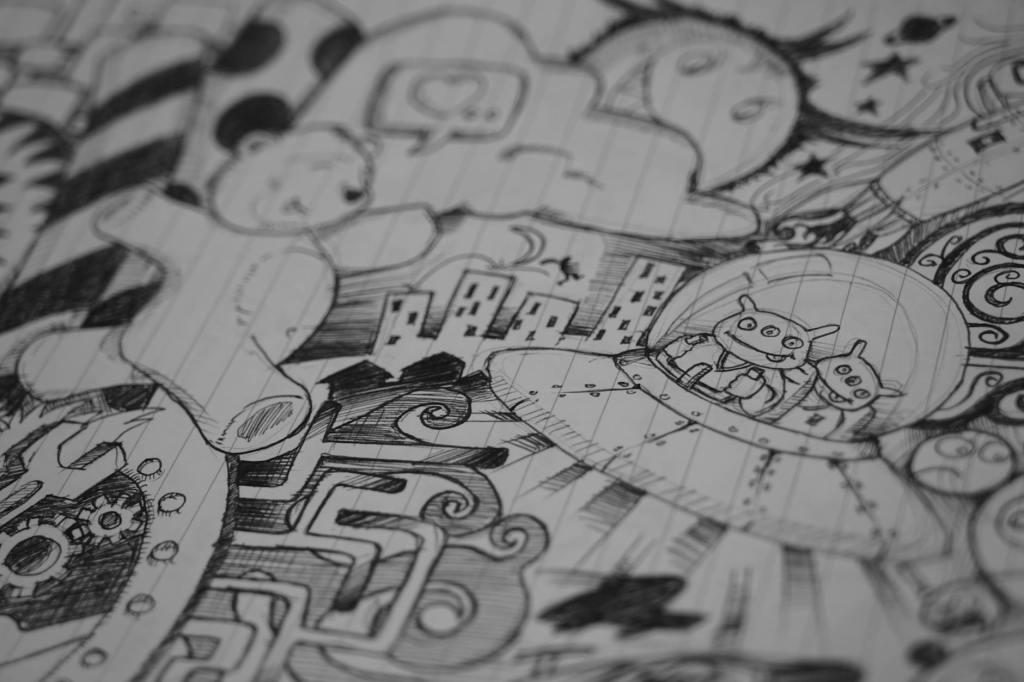
I’ve been tapping into my sense of creativity quite a lot this year, and I’ve found it taking many different forms. I’ve always been drawn to writing, and for most of my life this has been my primary method of creative expression. I think it’s considered a bit more serious, along with painting and elaborate drawings. However, these can be quite intimidating methods of expression, especially if you get in your own way by doubting your talent levels. That’s where doodling comes in!

Less intense than other creative pursuits, doodling is particularly accessible. It doesn’t require any real “talent” – not that perceived talent (or lack thereof) should necessarily impede your desire to create. It doesn’t require any fancy materials. It doesn’t even require any thought.
Why do we doodle?
How many times have you sat in a rather boring meeting, lecture, or lesson, and found yourself doodling on your notepad? Why do you think it happens? According to a report published by Harvard Medical School, doodling is considered a form of fidgeting. It can manifest as a desire to stay awake in particularly dull moments. It also provides your brain with a break from things you don’t find interesting. It can also be beneficial in these circumstances, as the study highlights that it can help in aiding the retention of information.
When I was teaching, I often had to reprimand students for doodling in their books, as there were strict guidelines on the presentation of exercise books. It wasn’t something I enjoyed doing if the doodles weren’t offensive – especially in light of how it can actually be beneficial to retaining information. It feels hypocritical, too! Every meeting I was in, I’d sit with coworkers and giggle at their doodles, or draw faces and symbols to express my boredom, irritation, and longing to be outside in the sun. I obviously found it beneficial in some way, and it was one of the many things that never sat right with me about teaching and being an authority figure.
How doodling can help you
It has low expectations: Doodling can be as absent-minded or as focused as you want it to be. The satisfaction of putting something on the page can be enough. Expressing a feeling can often reduce its impact. Allowing yourself to enter into a flow state – perhaps with the help of some music – can put your mind at ease and foster some truly creative stress relief. I find a messier, unfocused, approach to art can be far less stressful than actually having something in mind – a defined end goal can often put up roadblocks for my expression.
It shifts your focus: As outlined previously, doodling can offer a momentary distraction. The repetitive motions of some doodles can be quite soothing. In the long run, it can aid the retention of information. When we’re paying attention to something, the worries and stresses that typically surround is may seem to melt away.
It can unlock ideas in our subconscious: As someone who looks for symbolism and interpretation in virtually everything, it’s no surprise to me that some people have used doodle interpretation to understand emotional problems in patients. Next time you catch yourself doodling, pay attention to what it is you’ve drawn, and you might learn something about yourself!
Doodle ideas to help you get started
- Faces and emotions: Simply begin with drawing faces that represent how you’re feeling! It doesn’t have to be anything extravagant; it could be a simple as an old-fashioned emoticon.
- Nature-Inspired Doodles
I love to create simple patterns inspired by nature—flowers, leaves, vines, and weather illustrations. These shapes are inherently soothing to draw and can help you feel connected to the natural world, no matter where you are. Always a good one to tie with symbolising your emotions, you might invoke a little pathetic fallacy into your doodles – for example, drawing a raincloud to express sadness! - Abstract Patterns and Shapes
Sometimes, the best way to relax is by creating simple, abstract patterns. Focus on geometric shapes like circles, squares, or triangles, and let your hand move freely as you fill the page. The goal isn’t to make something perfect, but to create something from a space of ease. Random lines that intersect can make some interesting patterns, too.
If you’re approaching your doodles in an explicitly mindful way, it can also help to verbalise an intention before you start drawing. This could be as simple as “I want to relax” or “I want to clear my mind.” As you doodle, focus on the intention and let your mind rest.
If you’d like to join an online community that is centred on creative expression, I’d love to see you over at Connect to Create!

There is an extensive library of doodle content existing across social media platforms, suggesting that many people find it relaxing even if they are just watching someone else doodle if you’re ever looking for inspiration! I quite enjoy HuArtDrawing over on YouTube. However, I think it’s sometimes best to just let your pen lead you and not always try to recreate something you’ve seen.
So – what are you waiting for? Embrace the rebellious child within and deface your meeting notes with some doodles!


 The Opaque Elephant
Leave a reply to A Journey with Abstract Art: Inky Landscapes – The Opaque Elephant Cancel reply