
Using my tarot cards is one of my favourite methods of reflection, and I typically engage with my deck towards the end of the month. I like to reflect on the month I’m leaving behind, and look towards the month ahead, using the cards as reflective prompts.

Whilst I don’t think that I should base any major life decisions purely on what the cards seem to be telling me, I think tarot cards can be a useful tool in unlocking what is in my own subconscious – similar to interpreting a dream. For example, I don’t think it’s actually helpful for me to look at the cards as being able to predict when I’ll fall in love, or when my life will be perfect, but I think interpreting the symbolism behind them can be extremely useful in guiding me to what I already know deep down.
When I first got my tarot deck, I think I let them blind me and based too many of my decisions on what the cards said. I think I now have a more balanced approach to them, and I think it’s important to embrace the whimsical whilst also staying grounded in reality – a point I’ll explore in a bit more depth later.
Let’s dive into how you can use tarot for a meaningful reflection at the close of each month, with some simple spread suggestions and tips to guide your practice.
Why End-of-Month Tarot Readings Are Useful
- They Offer Reflection and Closure
The end of the month is an opportunity to pause and reflect on the experiences, lessons, and challenges you’ve encountered. Using tarot cards can help you engage with this by forcing you to think about patterns, representations, and signs. - They Help You Set Intentions for the Next Month
Whilst I don’t think you should base your entire life around any divination, sometimes it can help you uncover what your actual desires and intentions are. Much like an emotional response to music or other media, how you respond to the message of the cards may reveal something about yourself. - They Promote Mindfulness and Self-Awareness
Depending on how you approach your tarot readings, they can become a bit of a ritual. I enjoy lighting some incense, minimising distractions to just some soothing music, and thinking about what I want to learn as I shuffle the cards. This allows me to cultivate a little moment of peace, before exercising my brain with a little unpicking exercise.
Designing a Spread
You can ask your cards any questions you want to, in any order you want to. I don’t think fancy layouts are really necessary, but they can be a fun embellishment if you want them to be.
Although many people are proponents of using more cards, I feel like this can turn a reflective reading into an overly-complex mission, and I typically limit spreads for myself to five or less cards.
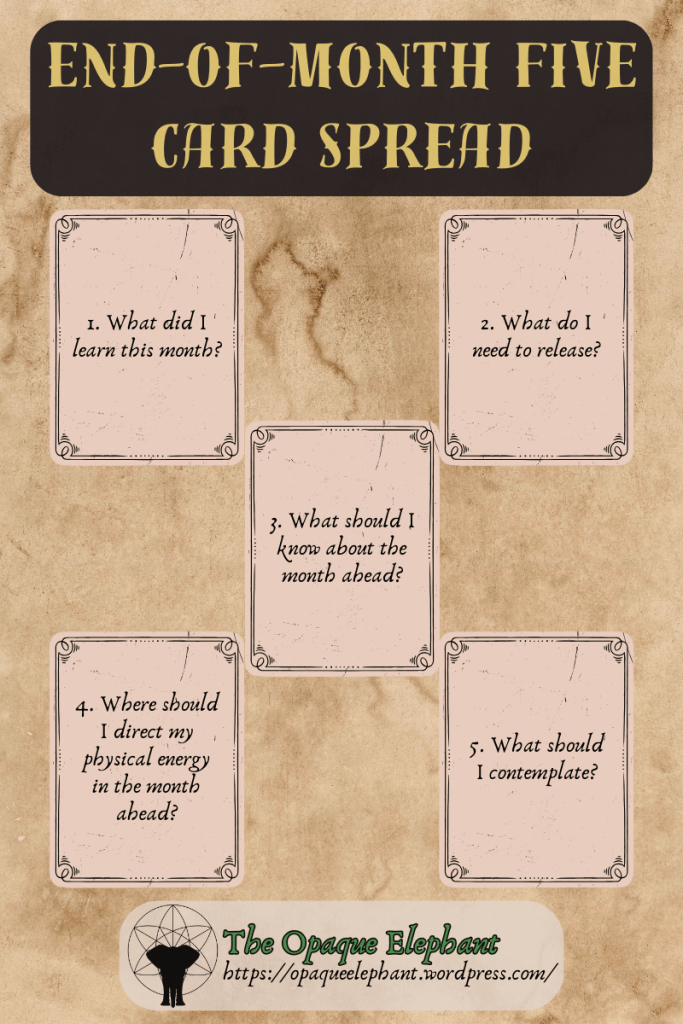
For an end of the month reading, I use these questions:
- What did I learn this month?
An opportunity to reflect, this card can help you summarise the month that has gone by. - What do I need to release?
Consider energies or situations you need to let go of as we move into the following month. - What should I know about the month ahead?
This may represent themes or ideas about what could happen in the upcoming month. - Where should I direct my physical energy in the month ahead?
Consider what you may need to focus on. Think about actions you need to take. - What should I contemplate?
Direct yourself to things you should consider as the new month unfolds, what you may need to ruminate on or research.
Although I’ve considered these questions as monthly spreads, it’s also easy to translate them into any other time period. When I feel like I need a little more guidance, I’ll sometimes change these questions to be about different time periods, like weeks or days.
How to Interpret Your Tarot Reading
When you’re getting started, it can be a little intimidating to engage with tarot cards – there’s often a lot of pressure to know the designated meanings and symbolism off by heart. However, I think this is counterproductive and doesn’t align with how I choose to engage with them.
Other readers may have different advice and opinions based on their relationship with reading tarot, and that’s fine! I don’t think there’s really a right or wrong way to engage with these tools, and over time you’ll develop your own form of practice.
If you’re unsure of where to start, you can try the following steps:
- Write down what immediately stands out to you about the card.
What do you think is happening in the card? How does that apply to your life or your situation? Go with your gut reactions – does it seem to be representative of something, does it make you feel a certain emotion? Think surface level first. - Delve a little deeper.
Pay attention to the smaller details of the card. What do you think the tiny details may represent? - Call for back-up.
If you’re still perplexed by a card, using a guide can be very useful. Any deck you use will have a small booklet included with interpretive keywords to support you in understanding your cards. I particularly love Truly Teach Me Tarot – they offer stories of the cards, people and situations they may represent, and extensive keyword lists. Although I primarily try to engage with my own understand of what is being shown on the card, I sometimes need a little bit of help in understanding it. - Consider how this applies to your life.
The cards can’t really reveal anything to you without you considering the context of your life. They should prompt you to think about facets of your life, like relationships or work. - Remember that you make the decisions.
Whilst tarot can help illuminate things in your life – they may suggest to you that a different career is going to be beneficial, for example – you shouldn’t take this as a hard-an-fast piece of advice. It should be viewed as the cards revealing that you already had a desire to change, and you should start thinking about the steps to take.
If you’re not quite ready to take the plunge in doing readings for yourself, you may want to consider receiving an intuitive reading from me. I now offer digital readings via Ko-Fi and Etsy which are fully customisable to your needs and questions, or you can use one of the spreads from my blog as inspiration.
If you want further support in exploring the meaning of your cards and spreads, why not explore some of the premium resources I have available via Ko-Fi and Etsy for digital download?

Looking at it in Practice
For a while, in every weekly spread I tried, I drew the infamous Tower card. Whilst I could have allowed this to be a disaster for my mental health – indeed past me probably would have spiralled at this – I considered how this should, could, and did apply to my life. Its imagery implies death and destruction, chaos abounding, and everything crashing down around you.
Which, I guess, in some ways was absolutely true. Certainly in terms of my career, and some distancing from friends.
However, sometimes we need to let go of things that aren’t healthy for us. Sometimes we need to burn everything to the ground (metaphorically) to start again. The constant pulling of this card was, then, a wake up call that it was time to change my life, to find something that did serve me instead of where I actually was. Whilst some of the destruction was out of my control, I could either stay there as the building crumbled around me, but to embrace the chaos as an opportunity.
How have you been using tarot to guide you? Do you have any other end-of-month questions you think I should add to the spread?


 The Opaque Elephant
Leave a reply to Tarot for the Month Ahead: Four-Card Spread – The Opaque Elephant Cancel reply