
This month, I’ve decided to focus on the theme of self-love. We’ve explored a few different ideas already, from ingredients for witchy rituals, to exploring self-love through journalling.
Last week, I talked about creating the right environment for yourself and the week before, I discussed loving your body. There was also a post last week with some writing prompts to explore the concept.
On the last post mentioned, there was a really interesting question raised by a commenter about synonyms for self-love, and how many of the synonyms provided by Google seemed negative, as if to imply that self-love itself was narcissistic. I wanted to explore this idea a little bit more with some further research and reflection.

What is the shadow side?
In Jungian psychology, the “shadow” refers to the darker side of your personality – the parts you may want to repress or not acknowledge. The Society of Analytical Psychology has a very insightful article full of examples and explanations.
In terms of this post, I’m using shadow to refer to the underbelly of something that seems to be littered with love and light – the darker side of it that we don’t always recognise.
What does self-love mean?
For me, I’ve always considered self-love to be a positive thing. It has connotations of confidence, care, and compassion for yourself to me.
To me, this looks like getting my self-worth from within the majority of the time, rather than relying on the thoughts, ideas, and validation of others. It involves me being sure of myself, proud of my achievements, and able to say nice things about myself.
There is, however, a slightly more selfish side to this. Sometimes, exercising self-love means I perhaps cut off my compassion for other people to protect my energy. It means not helping at every request, declining to be friends with people when the energy exchange doesn’t feel even. Sometimes it means making sure my needs are taken care of before other people’s needs.
If we consult the dictionary, we’re presented with a few different definitions that imply varying degrees of negative definition:
In American English:
- the instinct by which one’s actions are directed to the promotion of one’s own welfare or well-being, especially an excessive regard for one’s own advantage.
- conceit; vanity.
- narcissism ( def 3 ).
In British English:
- the instinct or tendency to seek one’s own well-being or to further one’s own interest
I think these definitions – particularly the American English ones – focus on the shadow side to the detriment of the positive side of exhibiting love for yourself.
Is it wrong to love yourself?
I was really riveted by the question posited to me in the comments, and it caused me to reflect on whether it actually is inherently wrong to love yourself, if it was narcissistic or overtly selfish to love explore self-love; if it is wrong to consider your needs or interests before the needs and interests of others.
As with everything, I don’t think it’s a direct yes or no.
I’m not sure I agree with the definition of it being an “excessive regard” for yourself, or that it’s conceited to recognise things about yourself that you admire. I much prefer the British English definition of the term – it seems far more balanced to me.
But it does raise an important question: is it wrong to prioritise yourself?
I’d have to say no.
I spent a very long time trying to look after other people, trying to share positive energy with other people. I spent many years preoccupied with not giving myself enough credit, of not complimenting myself, and wanting to avoid being vain. But I think in doing so, I gave other people too much power over me.
In not setting boundaries to the access people had to me, I found myself doing a lot of emotional labour that always felt unbalanced. I still love providing emotional support to other people, but I do think that sometimes it’s important to be selfish to protect my own wellbeing.
When does self-love become narcissistic and self-involved?
I’m going to preface this with recognition that I think the word narcissistic is thrown around quite a lot today; I think it’s vastly overused considering how charged it is, and where “mildly selfish” may be better.
I think, sometimes, we can be overly reliant on the emotional labour of other people, and when they withdraw it, we’re very quick to assign them the label of selfish. They’re narcissistic for wanting to look after themselves. But, could the same not be said for those who expect the emotional labour? Is it not selfish of them to take but never give? To expect others to look after them emotionally under the guise of people being considerate?
I think if you’re constantly shutting down any emotional appeals or anything that might require you to give of yourself that it is problematic. I do see a lot of posts and memes around therapy speak, and people refusing to do anything for others under the guise of not being in a space to do so, especially if those making requests are supposed to be friends.
I think it’s very easy to get wrapped up in protecting your own energy to the point that you do nothing for other people – and I don’t think this is right. I think it isn’t conducive to actually being a good person.
However, I’ve also experienced people unloading a string of traumas on me without asking if I’m in a space to hear it before a friendship is even established. I’ve had people request or try to phone me multiple times per day when I’ve said I’m feeling unwell and need some rest because they’re feeling lonely. I’ve had people not respond to things I’ve said when I need support, only to reach out when something has happened to them and they want company.
There isn’t any balance in these interactions. While I don’t think relationships (platonic or otherwise) should be purely transactional, I do think they should be balanced. The scales may be uneven at different points in time, but I think it’s important to be reasonable and considerate.
Loving yourself enough to set boundaries, loving yourself enough to receive validation from within, or loving yourself enough to recognise you aren’t in the headspace to take on others’ problems shouldn’t be seen as an issue.
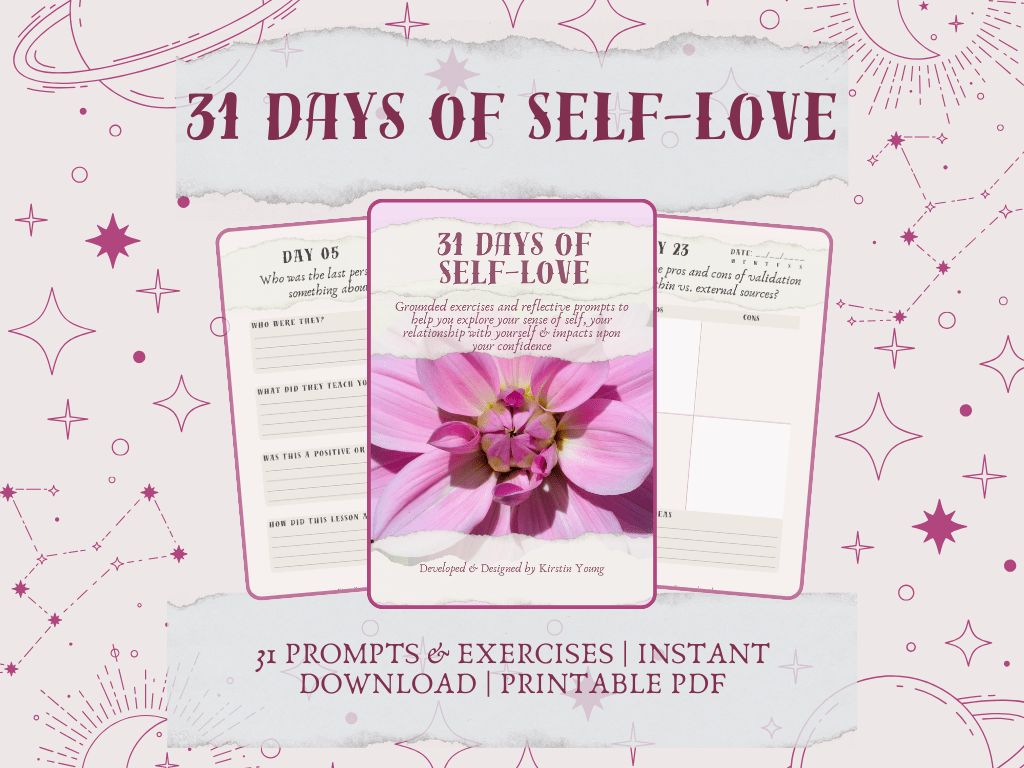
If you’re looking for structured writing prompts to support your self-discovery, I have several reflective eBooks available via Ko-Fi and Etsy for digital download 🙂


What are your thoughts? I’d be really interested to hear about what self-love means to you and how you keep your scales balanced!


 The Opaque Elephant
Leave a reply to The Opaque Elephant Cancel reply